
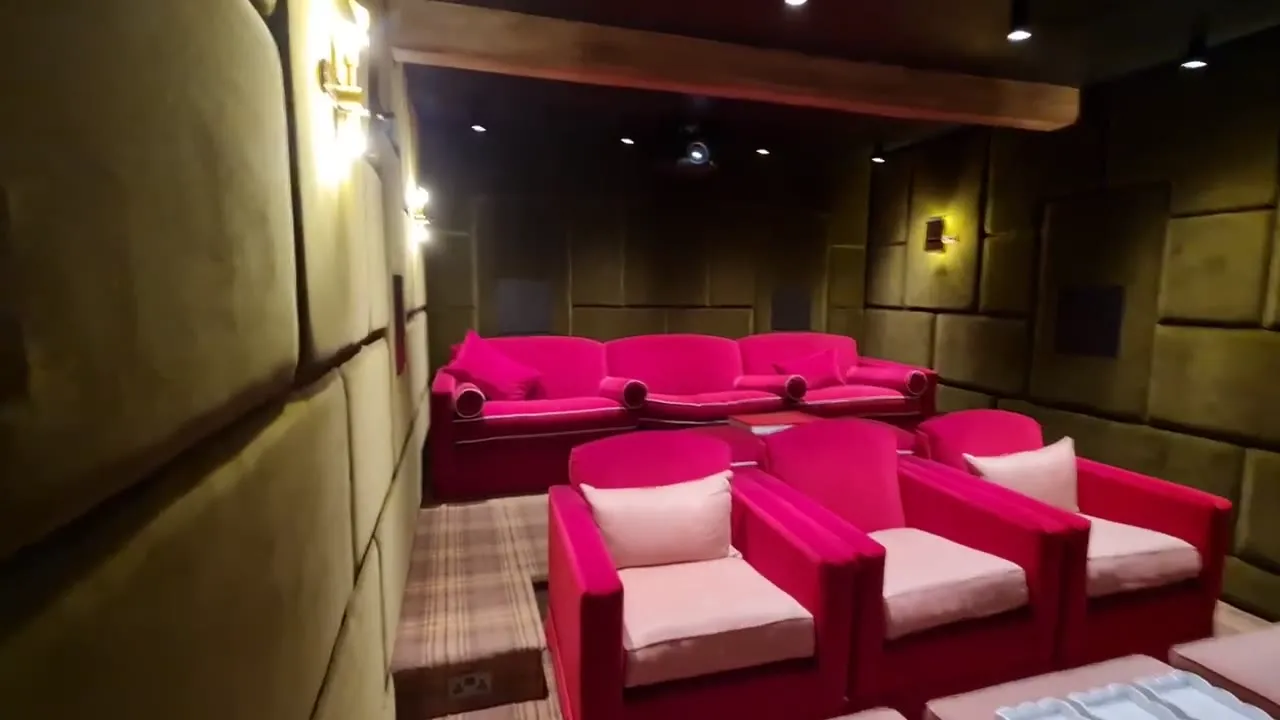
A proper cinema, not a big TV room.
The cinema was one part of a much larger new-build project for a private client. They wanted a real cinema experience: a large projected image, full Dolby Atmos sound and nine oversized seats. That's room for nine adults with space to spare, or eighteen children perfectly comfortably.
They didn't want a rack of equipment in the room, and they didn't want the room to look like a recording studio.
Dimensions, reflections and cable paths.
The room is roughly 3.5 m wide and 8 m long. A long, narrow room is good for projection throw and rows of seating, but it tends to produce strong reflections off the side walls and an uneven bass response down its length. Any light that bounces off pale walls or ceilings lands back on the screen and washes out the blacks.
Because it was a new build, the cinema could be planned before the walls went up. With the electronics moved out of the room, every signal and control path had to be designed in at first fix.
Fabric, projection, sound and control.
We built the room surfaces ourselves: bespoke wall panels made from an MDF frame, acoustic foam and a plush velvet face. The foam controls early reflections from the side walls. The velvet gives a dark, low-reflectance finish that stops stray light coming back onto the screen. The panels also let the loudspeakers and cabling disappear into the finished room.
The picture is a 120-inch fixed screen fed by a Sony VPL-VW590 native 4K projector. Sound is an eleven-speaker Triad Silver Series system with two subwoofers, decoded and driven by an Arcam AVR30 and PA410.
All of the electronics live in a purpose-built plant room outside the cinema. Video is distributed over WyreStorm NetworkHD, so the cinema shares sources with the rest of the house instead of needing its own boxes. Control4 runs the room: one command brings up the projector, the processor and the source together.
Measured first. Then listened to.
We don't plug a cinema in and walk away. We checked all of the Atmos processing, both with measurements and with the Mark 1 human ear, which is still the best way to judge how a room actually sounds.
A spectrum analyser identifies the exact frequencies that need attention. If a particular note makes something in the room resonate, and the vibration can't be physically locked down or isolated, it is dealt with in the DSP instead. The projector was set up properly too, to get the best picture it can give.
Then we spend time doing what the client will do: sitting down, watching and listening, and adjusting until it's right.
The engineering stays out of sight.
The client walks into a finished room with nothing visible but the screen, the seats and the speaker grilles. The electronics stay accessible in the plant room, so they can be serviced without disturbing the cinema finishes.