
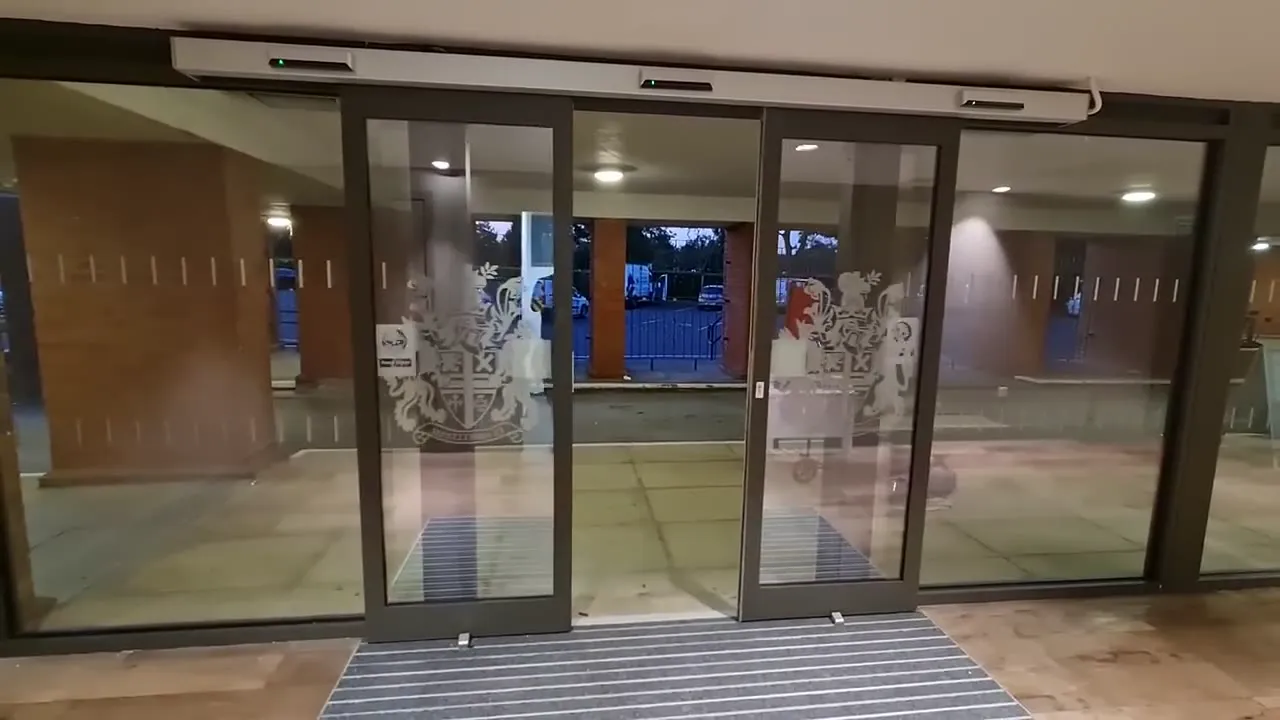
New automatic doors during a refurbishment.
St Helens Crematorium was being refurbished, and the work included new automatic sliding entrance doors. This was one of our preferred window and door company's projects, and they brought us in to install and commission the automation.
A building that never closed.
The crematorium remained open and in service throughout the refurbishment, so the work had to be done at night. Any work started in a public area had to be finished, or left safe and fully usable, by the end of each shift.
A public entrance like this is used by people of all abilities, often in large groups and at emotional moments. It has to open reliably, move smoothly and quietly, and detect anyone in the opening.
Working nights also means there's no technical support at the other end of the phone. If a piece of equipment doesn't behave as expected out of the box, you have to solve it yourself, before morning.
Label Eterna 90 with Optex sensing.
We fitted Label Eterna 90 sliding-door operators, with Optex sensors providing both the activation sensing and the safety beams. Activation and safety were commissioned together, because on a public entrance the operator can't be considered in isolation.
A missing part, and a door that still had to work.
One of the doors arrived with parts missing. The pair should run in a proper master–slave arrangement, but that couldn't be completed that night, and the entrance still had to be usable when the building opened.
So we set both doors to run on a timed delay from the same trigger. That kept the entrance working safely in the meantime, and we installed the proper master–slave link 48 hours later once the parts arrived.
The entrance works as an entrance.
The building got its new automatic entrance without closing for a single day. It's a different kind of job from home automation, but the skill set is the same: mechanical movement, electrical supply and the safety logic that controls them.