Get around the house without help.
The client uses a powered wheelchair and has limited reach. He's perfectly at home with a mobile phone: if you were exchanging emails with him, you wouldn't know he had a disability. What he couldn't do was get through the doors of his own home without someone else.
He needed to move between rooms, get outside, and call his lift to take himself upstairs to his bedroom and to the games room that doubles as his cinema.
Push pads and sensors weren't the answer.
A standard automatic door is opened with a push pad, and his reach meant he couldn't use one. Motion sensors, which work well in shops, are entirely inappropriate in a private house: a door that opens whenever someone walks past it isn't secure.
So he needed a secure interface he could reach every time. He already used his phone confidently, and Control4 fitted the bill perfectly across lighting, AV, blinds, doors and more.
Doors, locks and controls as one system.
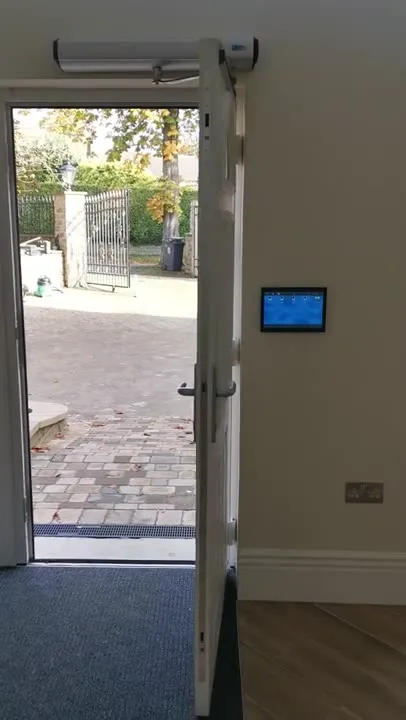
The door in the video is a composite door. Composite doors are heavy and stiff compared with internal doors, so the operator has to be sized for the door, not just fitted to it. We fitted a CDVI operator and interfaced it with Control4, so the client opens and closes it from the same app he uses for everything else in the house.
Other doors around the property were automated in the same way, including a set of uPVC double doors to the outside and a pair of internal double doors.
The wrong locks turned up.
On this job we weren't working with our usual window and door company. The client's preferred supplier arrived on site with frames fitted with electronic locks that were completely unsuitable, and not what we had specified.
That affected the uPVC double doors, and we rescued it. We sourced CDVI electronic shoot bolts that could work with a pair of uPVC doors, fitted them into the frames, and worked out how to wire them to the operators. The hard part was the sequence: the locks have to release fully before the operators try to open the doors, and the shoot bolts have to throw to lock the doors whenever the operators aren't in use.
A massive amount of independence.
The client can now open doors around his property, call his lift and take himself upstairs, all from his phone. It's independence he would not otherwise have had.